Designed for Every Environment
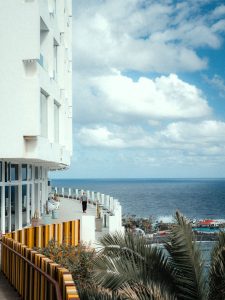
Whether in hotel complexes, around pool areas, in landscaping or for voice alarm across open spaces: wherever loudspeakers are used outdoors, the environmental conditions place far higher demands on them than a protected indoor setting does.
Outdoor audio is therefore a discipline in its own right, with particular demands on materials and engineering.
Salt Air
One of the most underestimated strains is salt air. Near the coast in particular, or at hotel resorts right by the sea, salt particles settle on metal components and contacts and encourage corrosion, which attacks connectors, screws and conductive parts over months and years, often unnoticed, until performance is genuinely impaired. A considered choice of materials counteracts this. Connectors such as ceramic terminals withstand moisture and heat far better than conventional screw terminals, and on outdoor loudspeakers the mounting brackets, screws and other small parts are deliberately made from plastic or stainless steel rather than corrosion-prone standard metal.
UV Radiation
UV radiation should not be underestimated either. Without suitably rated materials, many plastic enclosures grow brittle over time, fade or crack, which reduces their mechanical stability and their protection against moisture. Hard-wearing, UV-resistant enclosure materials prevent exactly that and keep enclosures stable in shape and colour even after years outdoors. The mounting method plays a part too: a loudspeaker installed below ground or cast into concrete is exposed to wind, UV radiation and mechanical strain far less from the outset than a free-standing installation.
Temperature Fluctuations
Temperature fluctuations add to this, between summer heat and winter cold, sometimes with large differences between day and night. The repeated expansion and contraction strain enclosure materials, seals and electronics alike and can loosen connections inside the enclosure. Robust enclosure constructions and seals designed for the purpose absorb these movements, so that electronics and connections stay stable even after many temperature cycles.
Moisture and Precipitation
Protection against moisture and precipitation is just as crucial. If water gets inside the enclosure, short circuits and corrosion of electronic components become a risk, and in the worst case the loudspeaker fails. Condensation, which can form inside the enclosure through temperature changes, also takes its toll on the electronics over time, even when no water enters from outside. A carefully sealed enclosure construction prevents water from getting in from outside while at the same time reducing the build-up of condensation within.
Dust and Sand
At locations with a dry, sandy climate in particular, dust and sand present a strain of their own. Fine particles can settle in enclosure seams, on connectors or in front of the diaphragm, which can impair sound quality over time and wear moving parts further through abrasion. Here too, a sealed enclosure construction keeps particles from reaching the diaphragm, without any loss of sound quality.
Speech Intelligibility
For EN 54-24 certified voice alarm systems, speech intelligibility also plays an important role. Wind and precipitation can further affect the transmitted sound and worsen the intelligibility of announcements in an emergency. Specially tuned drivers that aim for clarity and speech intelligibility rather than sheer volume, together with loudspeakers that project sound directionally, counteract this and deliver announcements clearly and intelligibly even in adverse conditions.
An Example from Our Range
The DA-SG 80-200/T plus white-EN54 and the PRO 250-300/T plus white-EN54 from our range, among others, are designed specifically for outdoor audio and reliably withstand demands such as salt air, UV radiation and temperature fluctuations.
If you have further questions about our outdoor loudspeakers, our customer service team will be glad to advise you in detail.