In many industrial facilities, the air contains flammable gases or dust. A single spark from an electrical device can be enough to trigger an explosion. Yet these are precisely the places where warnings and instructions must get through reliably. Explosion-proof loudspeakers resolve this conflict.
What is an explosive atmosphere?
An explosive atmosphere forms when flammable gases, vapours, mists or dusts mix with air. If this mixture meets an ignition source, it can combust instantaneously. Explosive atmospheres are especially common in the following areas:
- Chemical and petrochemical industry
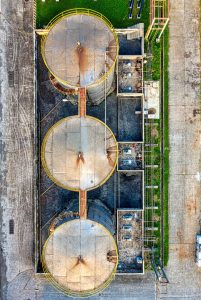
- Refineries and tank farms
- Biogas plants
- Paint shops
- Grain silos, mills and woodworking
Why aren’t ordinary loudspeakers enough?
Every electrical loudspeaker contains potential ignition sources. The transformer and voice coil heat up, sparks can occur at the connection terminals, and plastic surfaces build up electrostatic charge. Explosion-proof loudspeakers are designed to prevent these effects from igniting the surrounding mixture. This is achieved through standardised types of protection such as flameproof enclosure, encapsulation or protection by enclosure. Antistatic materials complete the concept.
Ex zones: how often does the hazard occur?
Directive 1999/92/EC classifies hazardous areas according to how often and for how long an explosive atmosphere is present. This determines the permitted equipment category:
| Gas zone | Dust zone | Explosive atmosphere | Permitted equipment category |
|---|---|---|---|
| 0 | 20 | continuously, for long periods or frequently | 1 |
| 1 | 21 | occasionally during normal operation | 1 or 2 |
| 2 | 22 | rarely and only briefly | 1, 2 or 3 |
The operator defines the zone classification in the explosion protection document.
ATEX: the legal framework in Europe
ATEX stands for “Atmosphères Explosibles” and refers to two EU directives:
- Directive 2014/34/EU (Product Directive): Aimed at manufacturers, it sets out the requirements that equipment and protective systems for potentially explosive atmospheres must meet.
- Directive 1999/92/EC (Workplace Directive): It governs the protection of workers and requires employers, among other things, to classify hazardous areas into zones.
For category 1 equipment and category 2 electrical equipment, the Product Directive requires an EU-type examination by a notified body. Compliant products bear the CE marking and the Ex symbol in a hexagon.
IECEx: the international certification scheme
IECEx is the certification scheme of the International Electrotechnical Commission (IEC). Unlike ATEX, IECEx is not a law but a voluntary, internationally recognised scheme based on the IEC 60079 series of standards. In addition to product testing, an IECEx certificate requires an assessment of manufacturing quality. It makes market access considerably easier, particularly outside Europe.
ATEX and IECEx compared
| ATEX | IECEx | |
|---|---|---|
| Scope | EU/EEA | international |
| Legal status | legally required | voluntary certification scheme |
| Technical basis | EN 60079 (harmonised) | IEC 60079 |
| Marking | CE marking and Ex symbol | Ex marking, no CE marking |
| Certification | EU-type examination certificate, EU declaration of conformity | Certificate of Conformity with test report (ExTR) |
Technically, the two systems are closely aligned, as the EN standards largely correspond to the IEC standards.
How to read Ex markings
An example of the marking on a device for gas atmospheres:
II 2G Ex db IIC T4 Gb
- II: Equipment group II, all areas except mining
- 2G: Category 2 for gas atmospheres, suitable for zones 1 and 2
- Ex db: Type of protection: flameproof enclosure
- IIC: Gas group with particularly easily ignitable gases such as hydrogen or acetylene
- T4: Temperature class, maximum surface temperature 135 °C
- Gb: Equipment protection level (EPL) for zone 1
Our solution: DK-EX 30/T
With the DK-EX 30/T, ic audio offers a 30W horn loudspeaker certified to ATEX and IECEx for zones 1 and 2 (gas) and zones 21 and 22 (dust). Its antistatic polyamide housing and IP66 rating make it a safe choice for chemical plants, biogas plants and grain silos.
Our sales team will be happy to advise you if you have any questions.